
Introduction
Artificial intelligence (“AI”) is a growing presence in our lives. Businesses increasingly use AI for many purposes, such as to analyze data and to reduce costs. For example, employers often use AI to screen applicants, evaluate resumes, and guide hiring decisions. These types of uses carry risk for businesses; for example, employment-related uses may produce outcomes that constitute illegal discrimination). In response to the risks posed by AI, several states have passed laws regulating its use.
State regulation
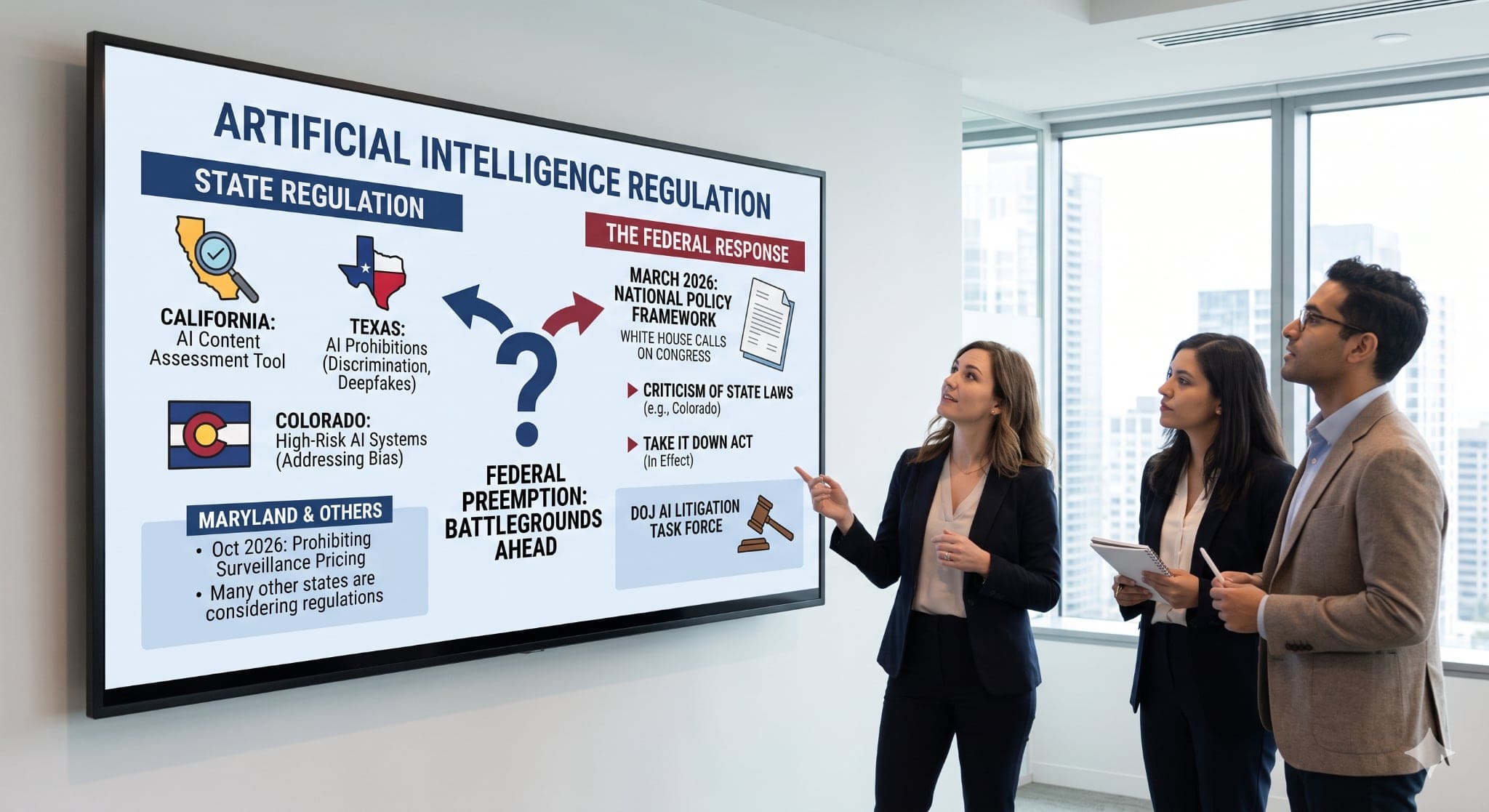
- California’s Transparency in Frontier Artificial Intelligence Act requires that any provider of content accessible in the state must provide a tool that allows users “to assess whether image, video, or audio content, or content that is any combination thereof, was created or altered by” the provider’s generative AI system.
- Texas’s Responsible Artificial Intelligence Governance Act prohibits the development or deployment of any AI system to intentionally encourage any person to physically harm themselves or others; to engage in criminal activity; to infringe, restrict, or impair a person’s federal Constitutional rights; to discriminate against a protected class under federal or state law, or to produce, assist or aide in producing, or distributing child pornography or unlawful deepfake videos or images.
- Colorado’s Artificial Intelligence Act regulates the development and use of what it defines as high-risk AI systems, which is one that may result in differential treatment or impact that discriminates an individual on their actual or perceived age, color, disability, ethnicity, genetic information, limited proficiency in the English language, national origin, race, religion, reproductive health, sex, veteran status or other classification under Colorado or federal law.
- Other states have passed or are considering additional restrictions on the use of AI. For example, starting on October 1, 2026, a Maryland statute will prohibit surveillance pricing, which is a practice that uses technology, such as AI tools, to set prices personalized to a particular customer. These technologies may use a customers’ personal data (including location, browser history, purchasing history and demographics) to set, recommend or adjust personalized prices.
The state of federal regulation
The looming question is whether the federal government will attempt to prohibit any state effort to regulate AI. In March 2026, the White House published its National Policy Framework for Artificial Intelligence. This framework contains an invitation to Congress to pass a comprehensive national approach to AI governance. It further targets state laws that in its view impose viewpoint-based obligations on AI developers or requires changes to truthful AI outputs. As an example, the framework explicitly criticized Colorado’s AI act, in that the framework interprets it to mean it could “compel AI systems to produce false results” to avoid statistical disparities across protected groups.
So far, Congress has declined to pass any legislation based on the framework, although it previously passed the Take It Down Act, which makes it illegal to knowingly publish or threaten to publish intimate images, including AI-generated deepfakes. That act is now in effect.
The future legal question
The central legal question going forward is likely to be a fight over the federal government’s authority to prevent state AI regulation. The Trump executive order adopts an “as-applied” approach rather than an attempt to freeze all state AI regulation, meaning the administration will challenge specific provisions it deems inconsistent with federal policy, rather than attempting a blanket ban. Courts will ultimately determine the scope of that power. Relatedly, in early 2026 the Department of Justice has established an AI Litigation Task Force. This task force is specifically charged with challenging state AI laws that the administration deems “innovation-limiting” or inconsistent with national policy. The reach and scope of the task force’s actions have not yet been determined.










0 Comments